AI Powered Intelligent Document Processing
Nanonets is an AI automation platform that enables businesses to extract, validate, and operationalize structured data from unstructured documents. What began as an OCR engine has evolved into a broader workflow automation system used by finance and operations teams globally.
Today, the company serves hundreds of mid market and enterprise customers and generates multi million dollar annual recurring revenue. The platform supports accounts payable and operational workflows that connect ingestion, validation, approvals, reconciliation, and reporting, with technology foundation that is powerful and deeply configurable.
THIS CASE STUDY
Designing for three different problem categores
This case study highlights three initiatives from my broader work at Nanonets, each representing a distinct category of design problem. Although the surface areas differed, they revealed fundamentally different challenges in system precision, information clarity, and behavioral momentum.
1.
Structural Integrity Problems When the system itself must be precise
PO Matching dealt with deeply structured workflow logic.
Line-level reconciliation, identifier mapping, balance tracking, and deterministic tie-breaking demanded system-level thinking, guardrails, and state management.
2.
Cognitive Load Problems When intelligence must remain usable
Analytics and Reporting addressed cognitive load within intelligence workflows.
As reporting depth increased, the challenge shifted to shaping powerful data exploration into a structure that finance teams could navigate confidently. Flexible filters, drill-downs, and natural language queries ensuring insight remained clear, actionable, and grounded in context.
3.
Behavioral Activation Problems When early friction determines momentum
Onboarding focused on understanding where users slowed down or disengaged during their first experience with the product.
By analysing real drop-off patterns, we identified moments of hesitation and uncertainty across the early journey.
The patterns helped us adjust the flow so users understood their next step, acted on it, and found reason to come back.
As Product Designer, I led concept development, interaction design, and user validation across these initiatives, partnering closely with engineering to translate structural, cognitive, and behavioral challenges into scalable product systems.
Operational Logic at Scale
PO Matching
Context
We built a native PO Matching block that allowed AP teams to define matching logic once, match invoices at line level, and continuously track remaining balances on POs without writing custom Python or doing ERP lookups. The feature enabled 1 PO ↔ many invoices, automatic balance tracking, and workflow-level control across AP models.
Tension
AP teams were manually reconciling invoices against POs across systems.
Line items had to be compared by SKU, quantity, and rate. Partial shipments complicated everything, and balance tracking was happening outside the workflow.
This was a system-level integrity problem. Precision could not be optional.

Design response
Product Architecture
PO Matching is built as a structured extension of the AP workflow. It connects setup, execution, and balance tracking into a single controlled system.
Core components included:
PO Matching Block
Source selection, identifier mapping, & matching logic defined.
Invoice-Level Matching
Side-by-side PO and Invoice matching with auto-selection logic.
Reduced operational load
Real-time tracking of matched & unmatched items on each PO line.
Model level Synchronised
Automatically updated with matched line items.
Together, these components ensure that every invoice-to-PO decision is traceable, measurable, and automatically reflected at the model level.
Exploration
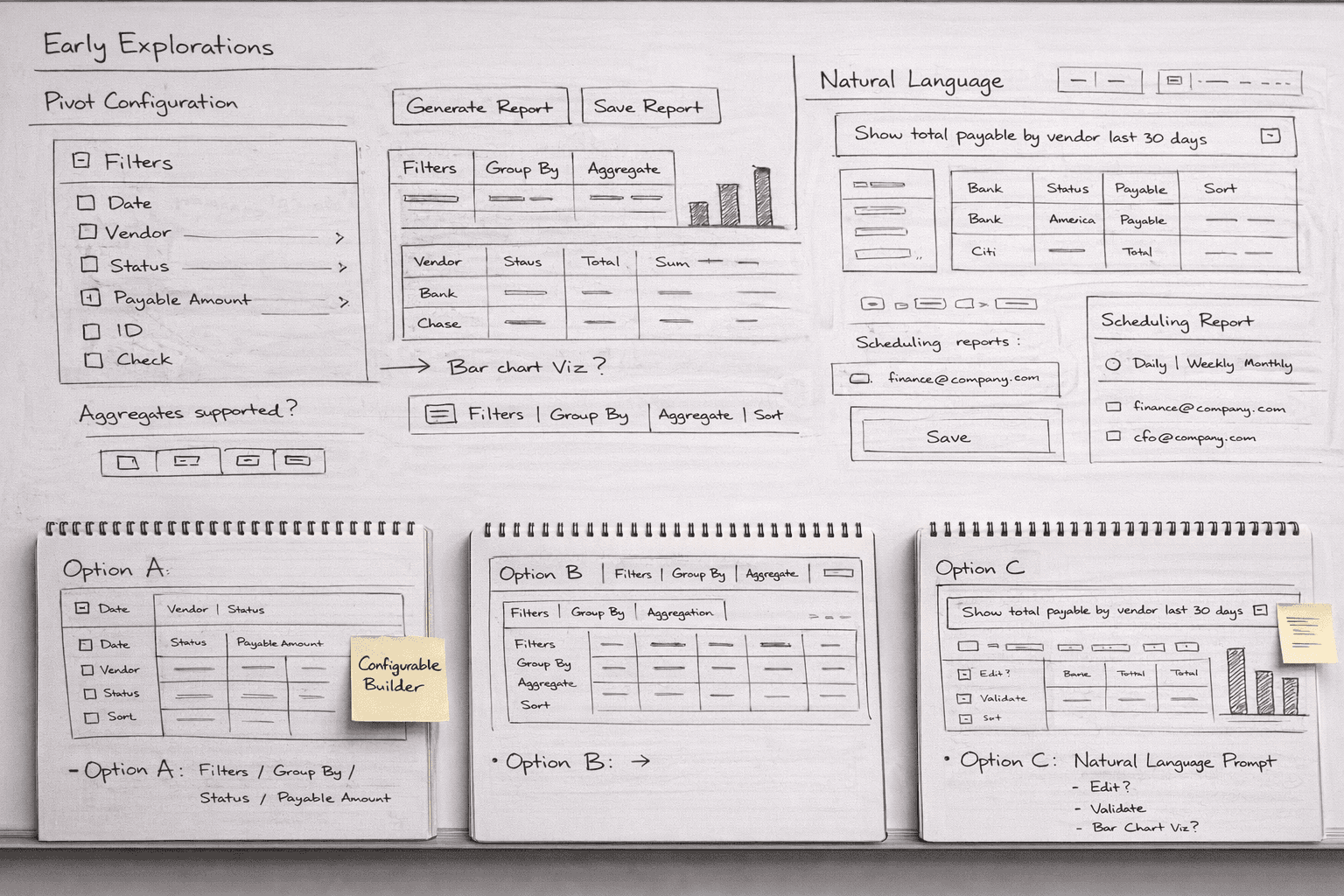
Multiple layout directions were explored to structure reporting logic and prompt-based querying. Early concepts tested configuration placement, prompt discoverability, and report preview hierarchy.
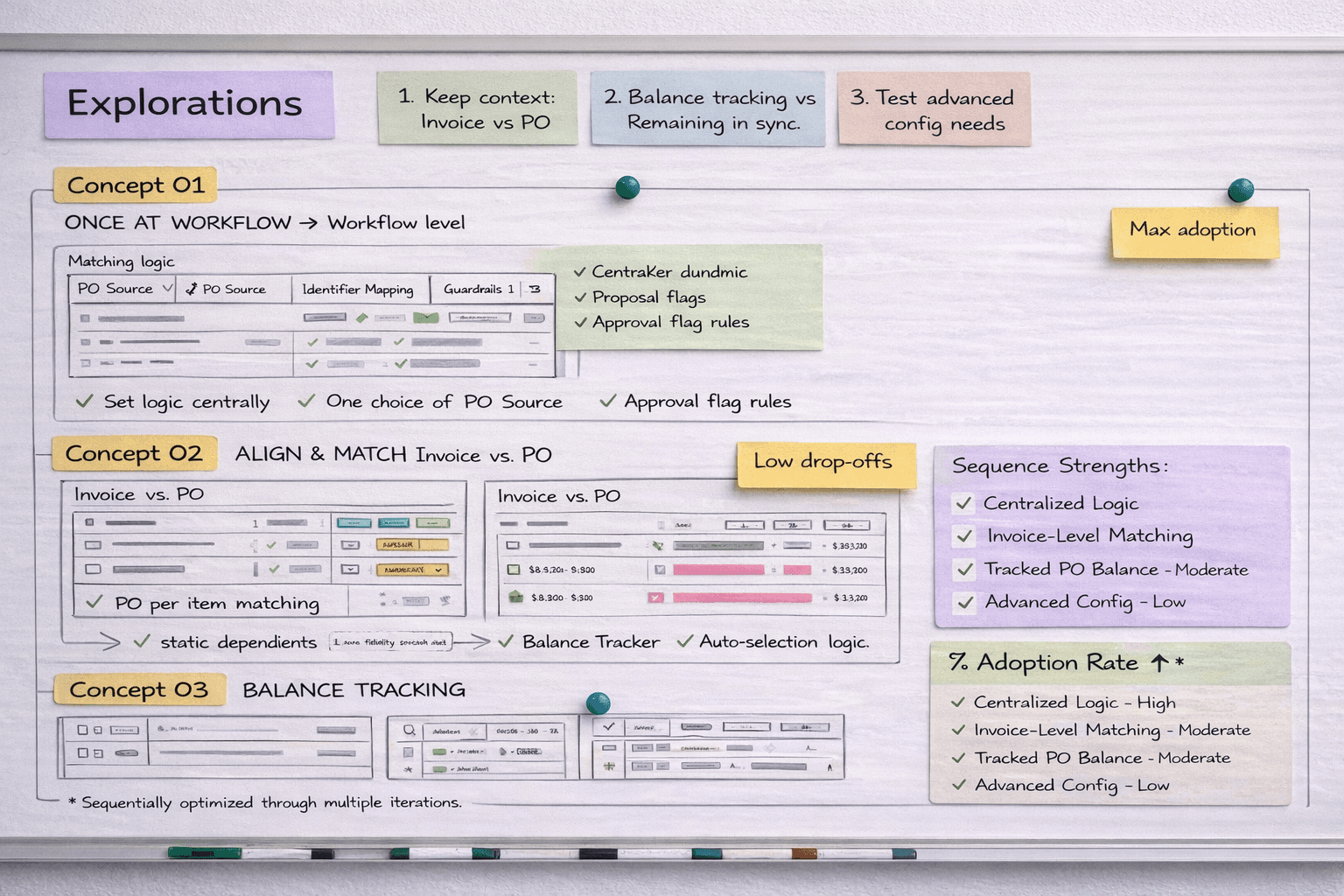
Designs
PO Matching connects rule definition, automated execution, and visual verification into a single controlled workflow that scales reliably.
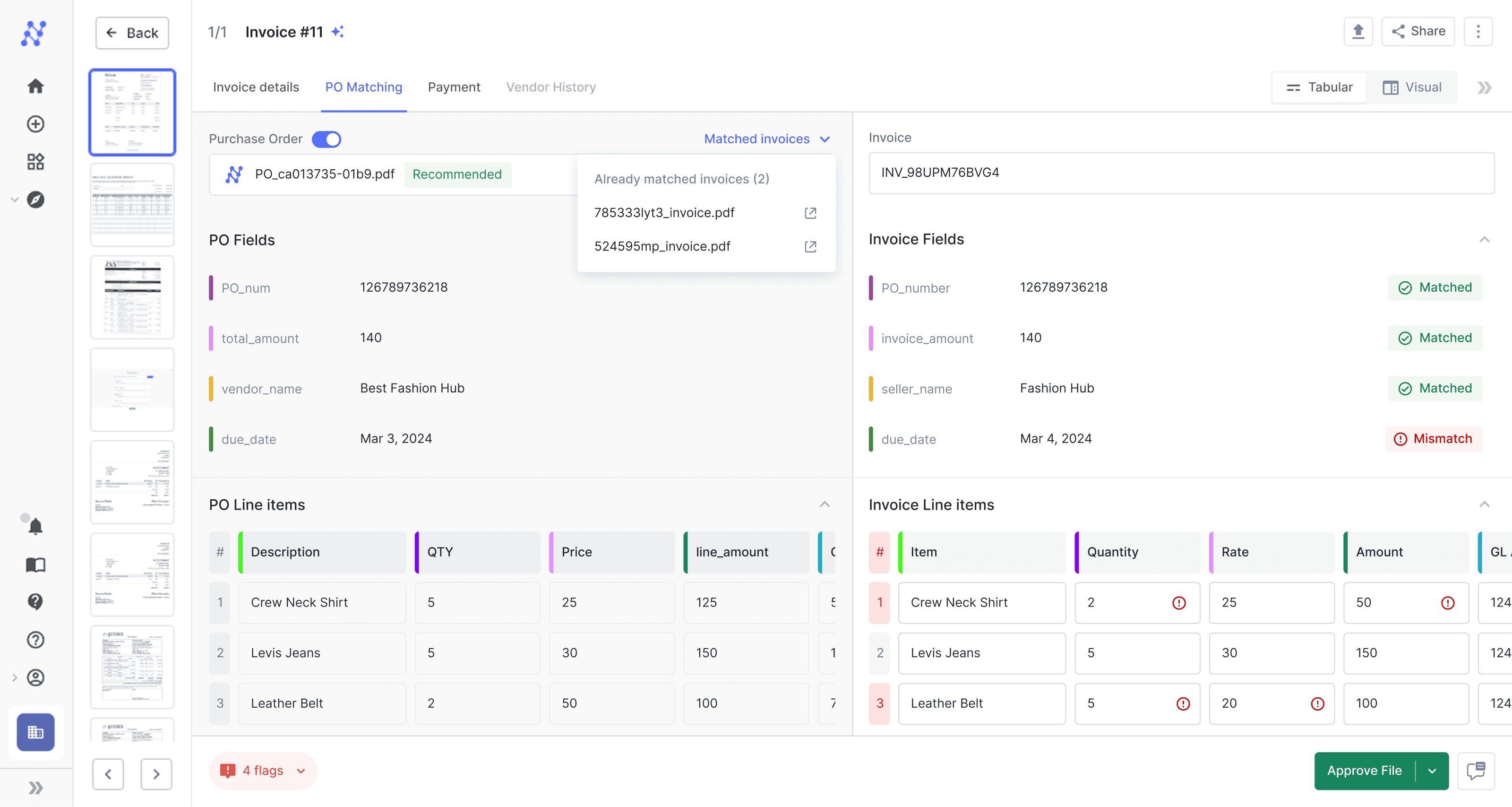
Side-by-Side Matching
PO and invoice fields are displayed in parallel with clear match and mismatch indicators, enabling quick line-level reconciliation and approval in one view.
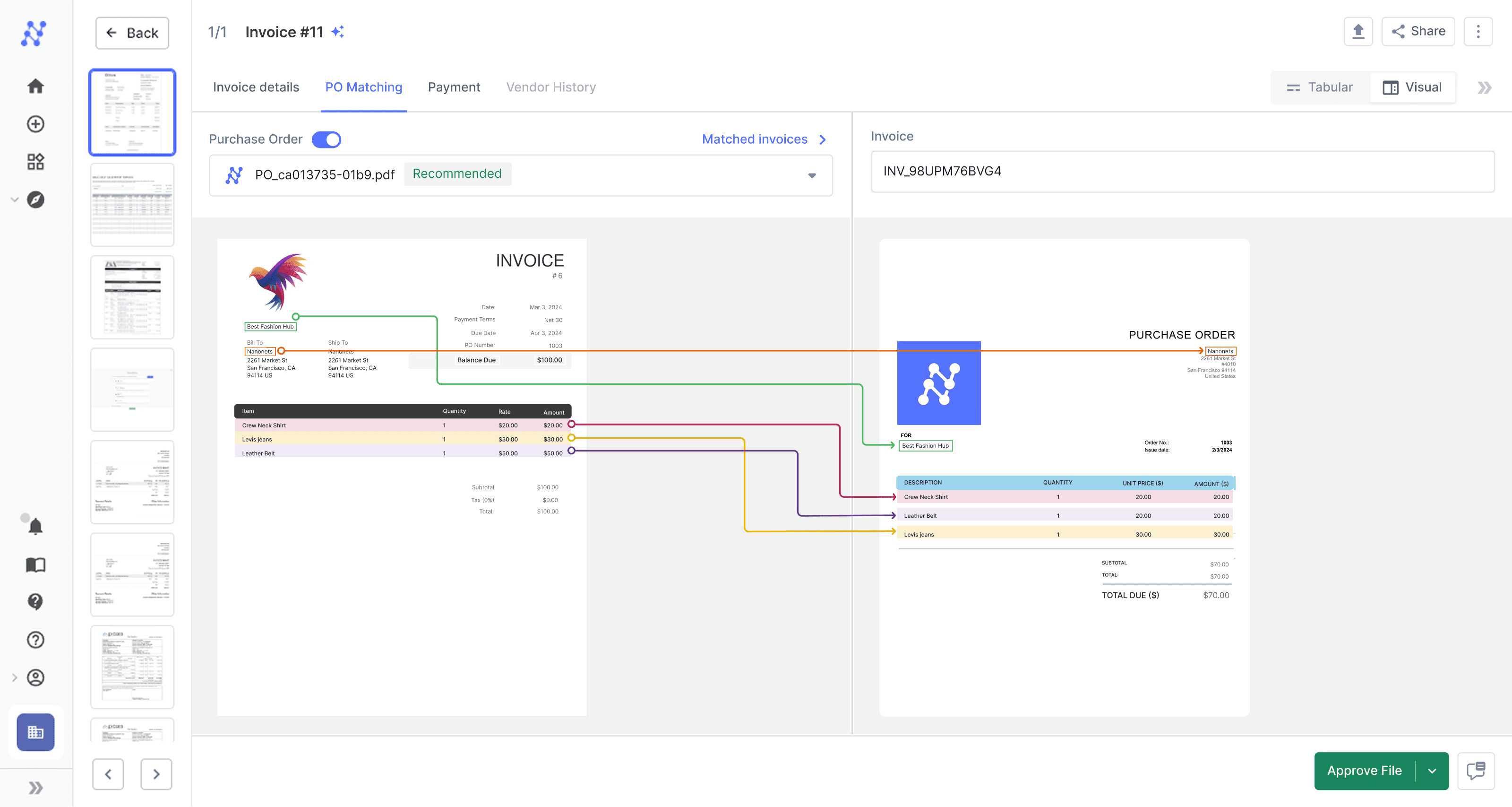
Document-Level Validation
Structured data is layered over original PO and invoice previews, allowing users to verify extracted values directly against source documents.
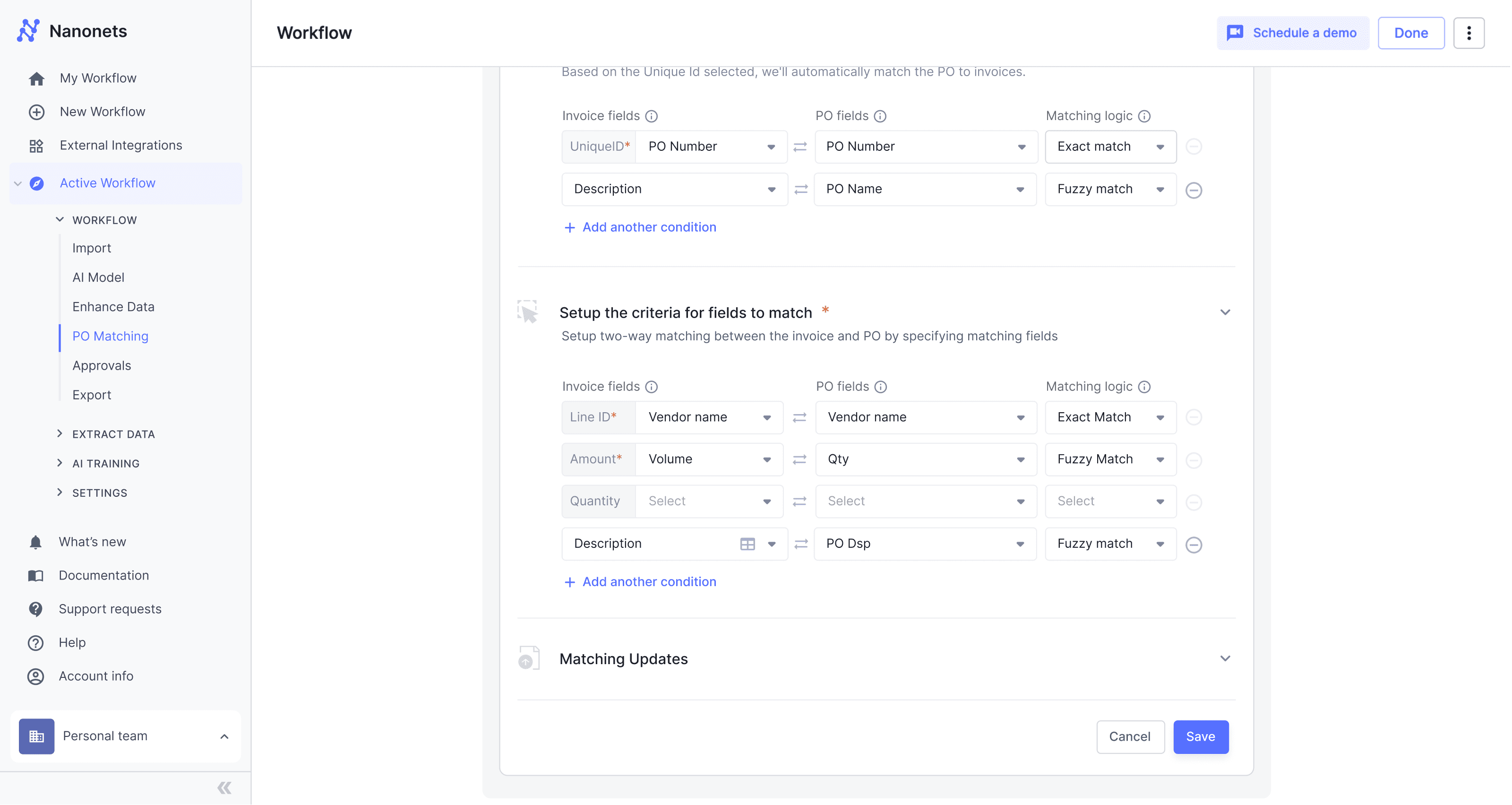
Workflow Matching Logic
Matching rules are configured at the workflow level by mapping invoice and PO fields using exact or fuzzy logic, ensuring consistent reconciliation across documents.
Outcome
PO Matching enabled line-level reconciliation inside the AP workflow without external scripts or ERP lookups.
The feature supported multi-invoice-to-single-PO matching, automatic balance tracking, and deterministic decision logic at scale.
Adoption began with paying customers by June 2024 and expanded across AP workflows handling high invoice volumes.
Reconciliation moved from manual comparison across systems to a controlled, model-level source of truth.
Operational Logic at Scale
Analytics & Reporting
Context
Analytics & Reporting is a structured reporting engine built for finance teams to generate, explore, visualize, and distribute operational data directly within Nanonets. It supports configurable reports using filters, grouping, and aggregations, natural language report generation, automated visualizations, and scheduled delivery.
With Nanonets serving over 10,000 customers globally, reporting adoption scaled across finance teams. Conservatively, over 1,000 active users generate reports regularly, with teams saving 5 to 10 reports and configuring recurring schedules for operational visibility. Reporting moved decision-making from manual extraction to self-serve, repeatable workflows inside the platform.
Tension
Finance teams need structured visibility into operational data to make decisions, monitor performance, and plan cash flow. Without a reporting layer, insights remain buried inside workflows and require manual effort to extract.
This was a comprehension problem. Capability existed. Usability did not.
Design response
Product Architecture
The reporting system was designed as a layered capability within the platform, combining structured configuration with AI-assisted exploration and automated distribution.
Core components included:
Configurable Reports
Filters, grouping, and aggregations
LLM Builder
Prompt to structured report translation.
Visualization engine
Auto-generated charts from data.
Scheduling
Scheduled report delivery via prompt or manual setup.
The architecture balances structured control with flexible exploration, ensuring that reporting remains powerful without becoming overwhelming.
Exploration
Multiple layout directions were explored to structure reporting logic and prompt-based querying. Early concepts tested configuration placement, prompt discoverability, and report preview hierarchy.
Designs
Design connects configuration, visualization, and distribution into a single structured system, translating processed data into decision-ready insight without separating logic from exploration.
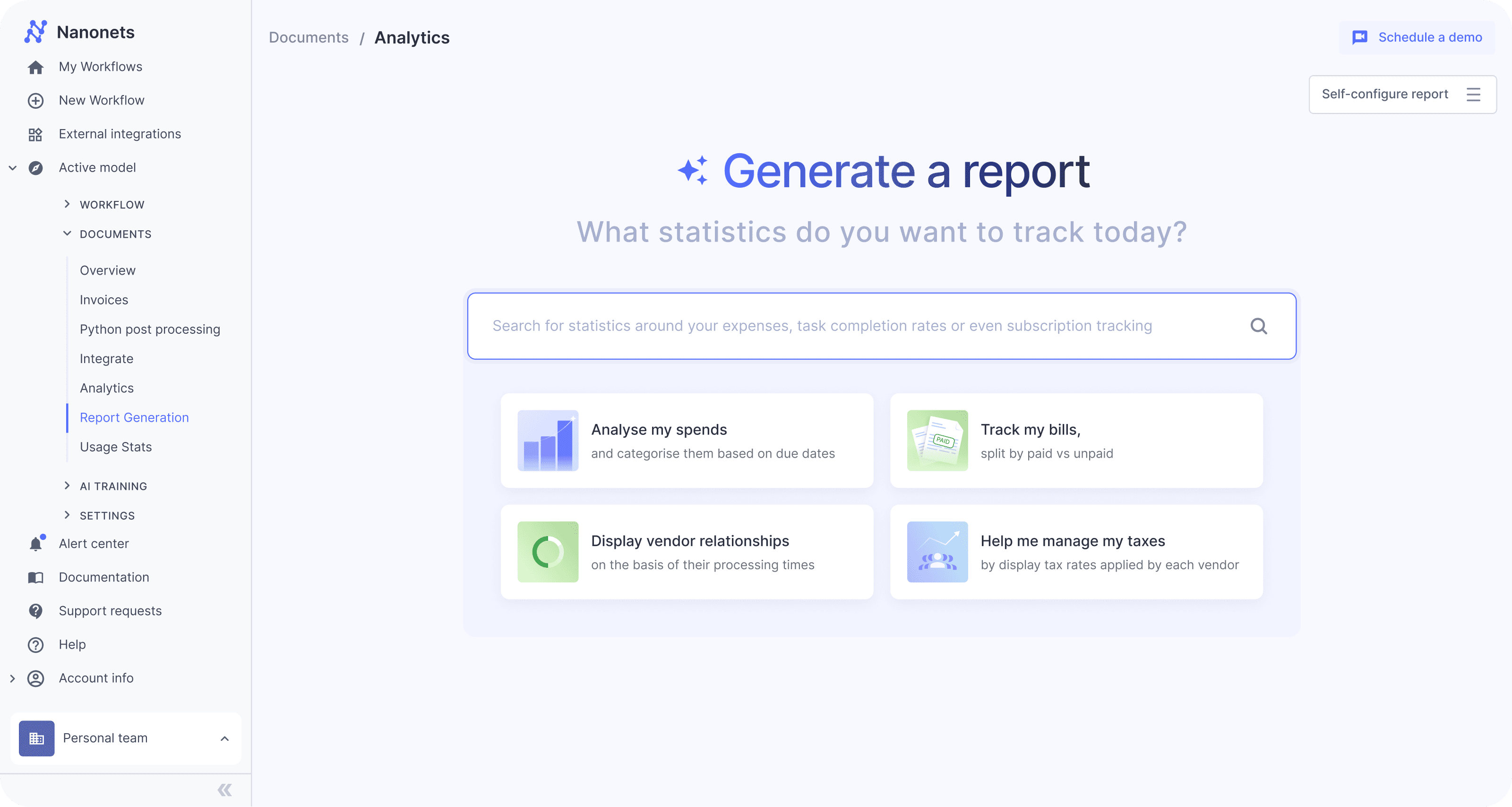
Generate a Report – Prompt-Driven Entry
Users describe the insight they need in natural language, and the system translates that intent into a structured report configuration, reducing setup friction while preserving control.
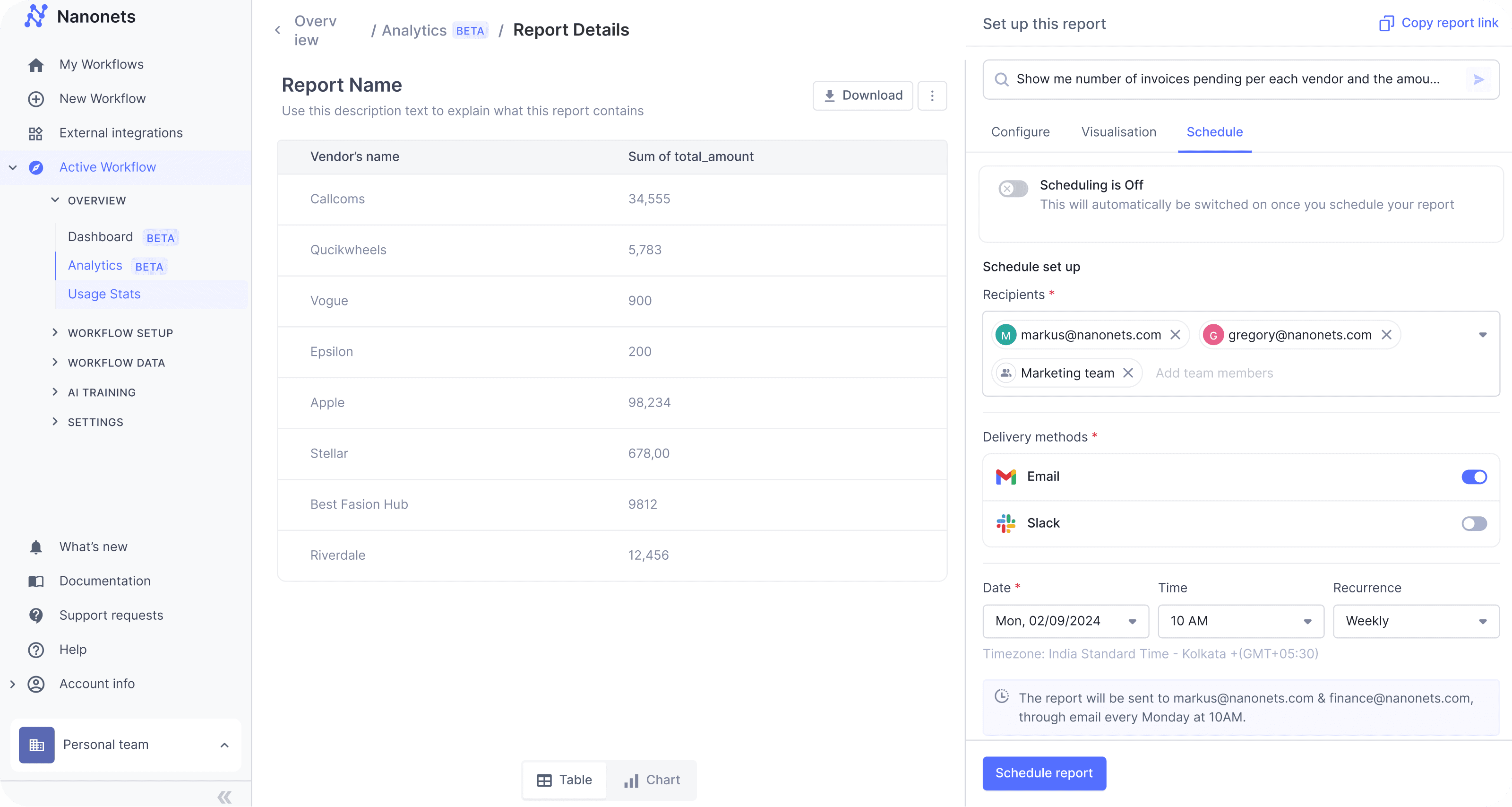
Report Details – Tabular View with Scheduling
Users configure report dimensions, define metrics, review vendor-level aggregates, and schedule automated delivery across email or Slack from a single interface.
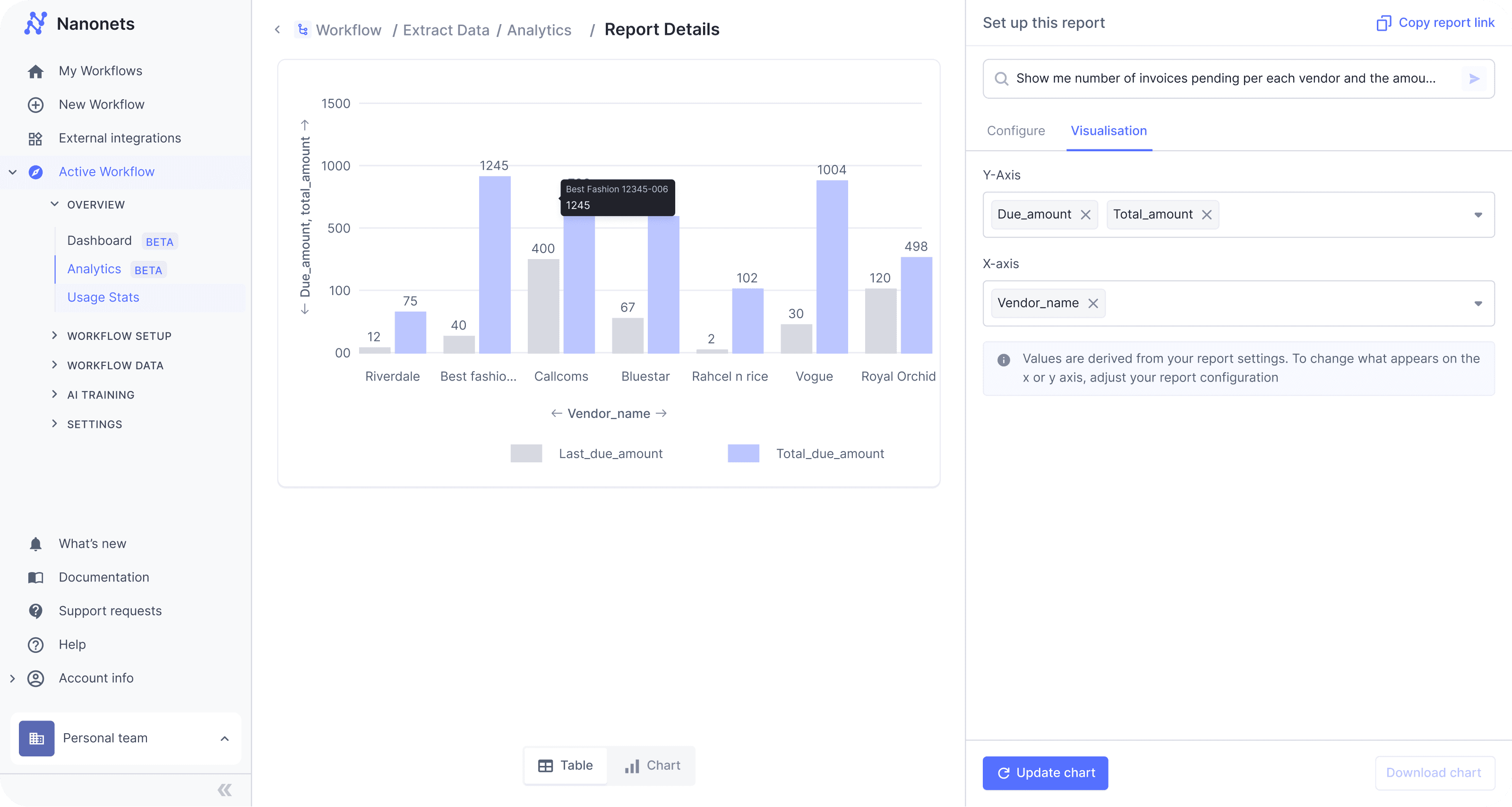
Report Details – Visualization Mode
Configured data is rendered into interactive charts, with axes governed by report settings to maintain consistency with structured logic while enabling flexible exploration.
Outcome
Reporting adoption scaled across finance teams, with over 1,000 active users generating reports regularly.
Teams shifted from manual exports to structured, self-serve analysis within the platform.
Recurring scheduled reports reduced repetitive data pulls and improved operational visibility across accounts payable functions.
Friction in First Interaction
Onboarding
Context
Nanonets requires onboarding for users to understand how AI driven data extraction works and to validate a proof of concept on their own documents. Files can vary widely in language, structure, quality, and orientation. Before moving to production workflows, users need to see that extraction performs reliably on their specific inputs.
At the time, overall onboarding drop off was close to 70 percent.
The target was clear: bring it below 40 percent.
Tension
Analytics showed three concentrated friction points.
30 percent of users dropped before uploading their first file. Many were unsure whether their document type would work or whether uploading would alter anything in their account.
8 percent exited while AI extraction was in progress. The waiting state felt opaque. Users did not know what was happening or how to evaluate success.
28 percent left immediately after completing setup. The completion state signaled finality rather than forward movement, and users did not proceed to workflow configuration.
The friction emerged at transition points where the next step was not clearly signposted, creating hesitation even though the system itself was functioning correctly and capable of delivering value.
Onboarding was therefore a momentum challenge, not a capability one.
Design response
Product Architecture
A structured onboarding framework that guides users from first upload to workflow setup through transparent processing and dashboard-first progression.
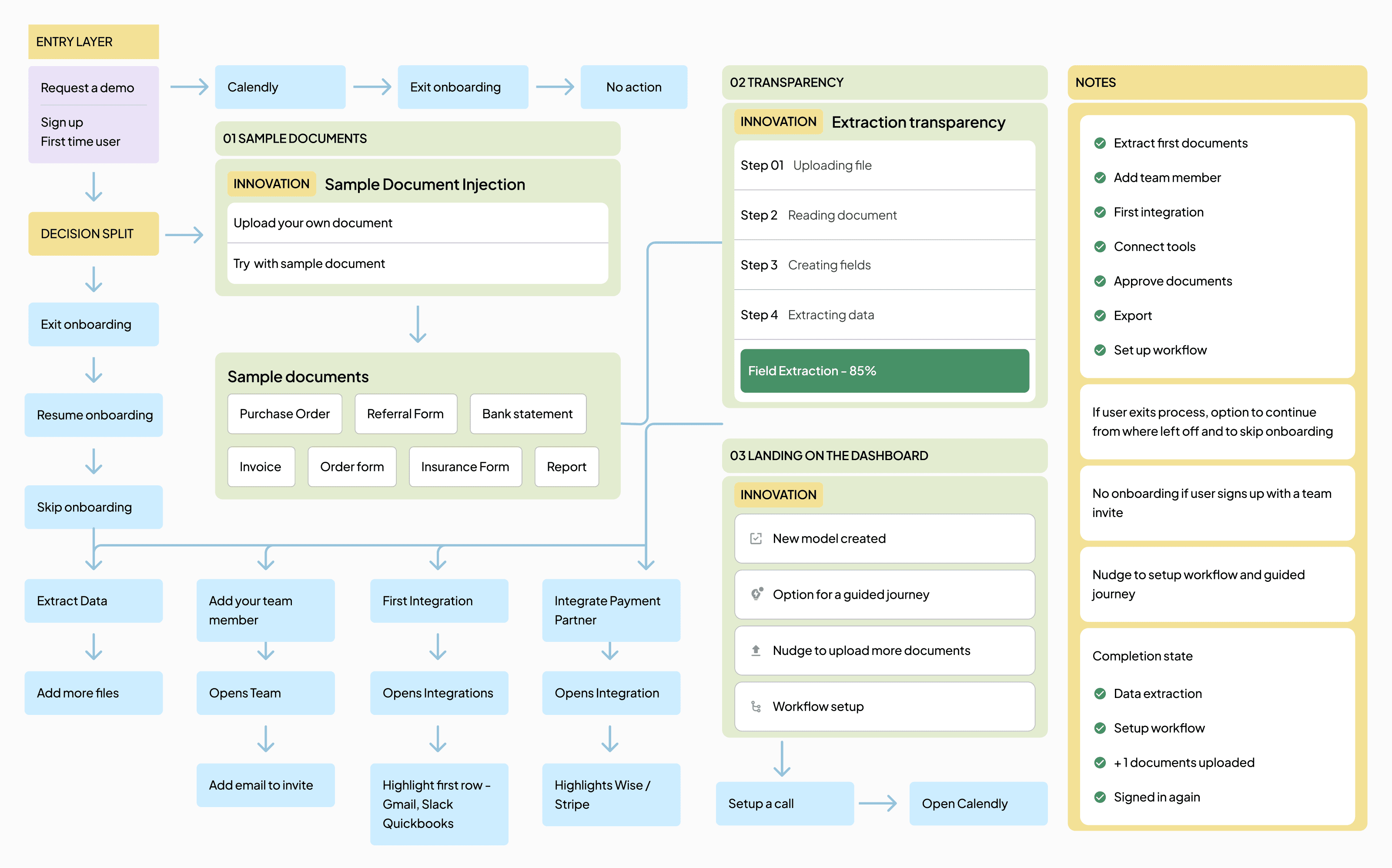
Exploration
Early onboarding concepts focused on lowering drop-offs by restructuring the entry point, introducing sample documents, adding a visible progress tracker, and validating improvements through user tests and A/B experiments.
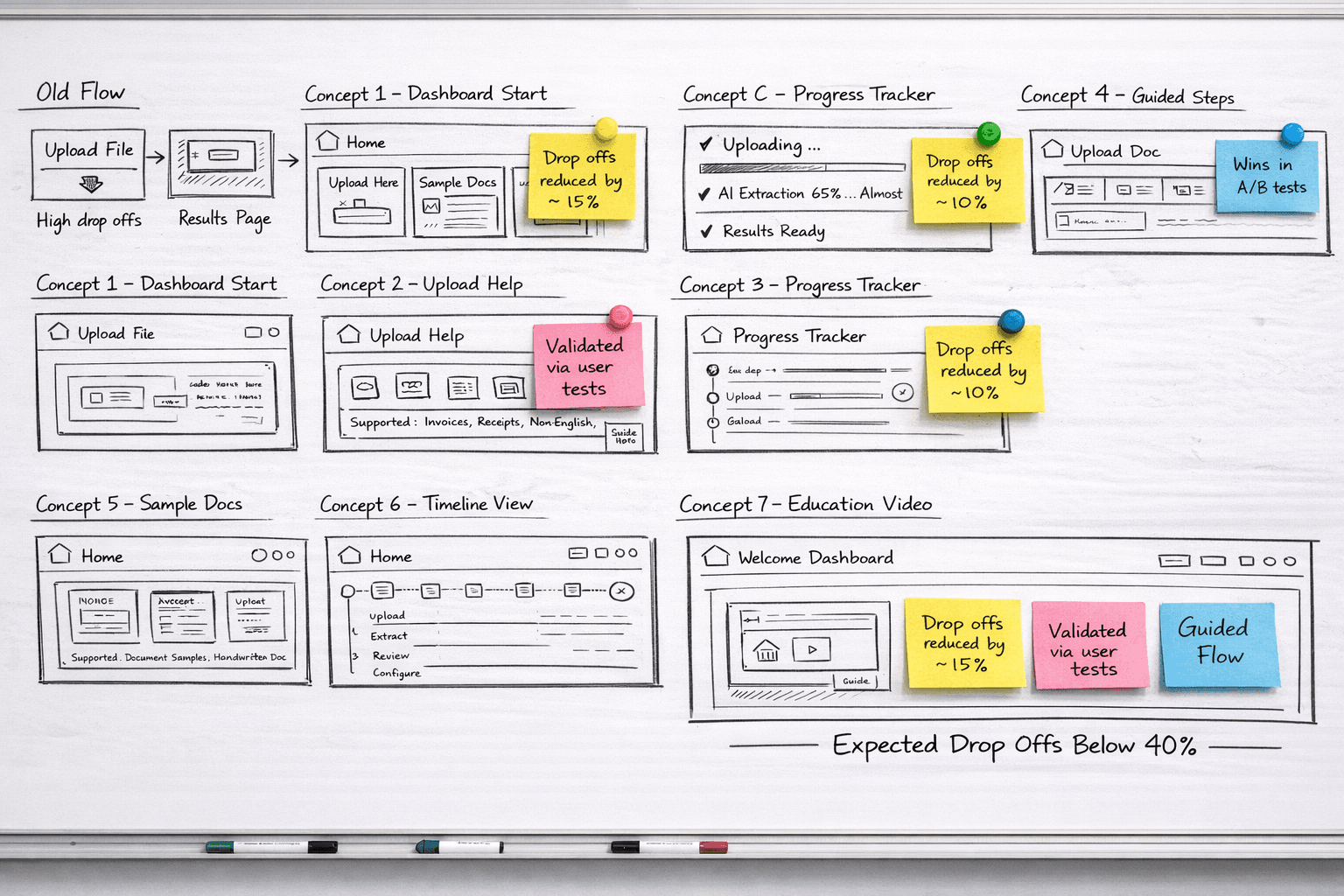
Designs
The final experience combines sample document injection, real-time extraction visibility, and guided milestones to drive activation and sustained engagement.
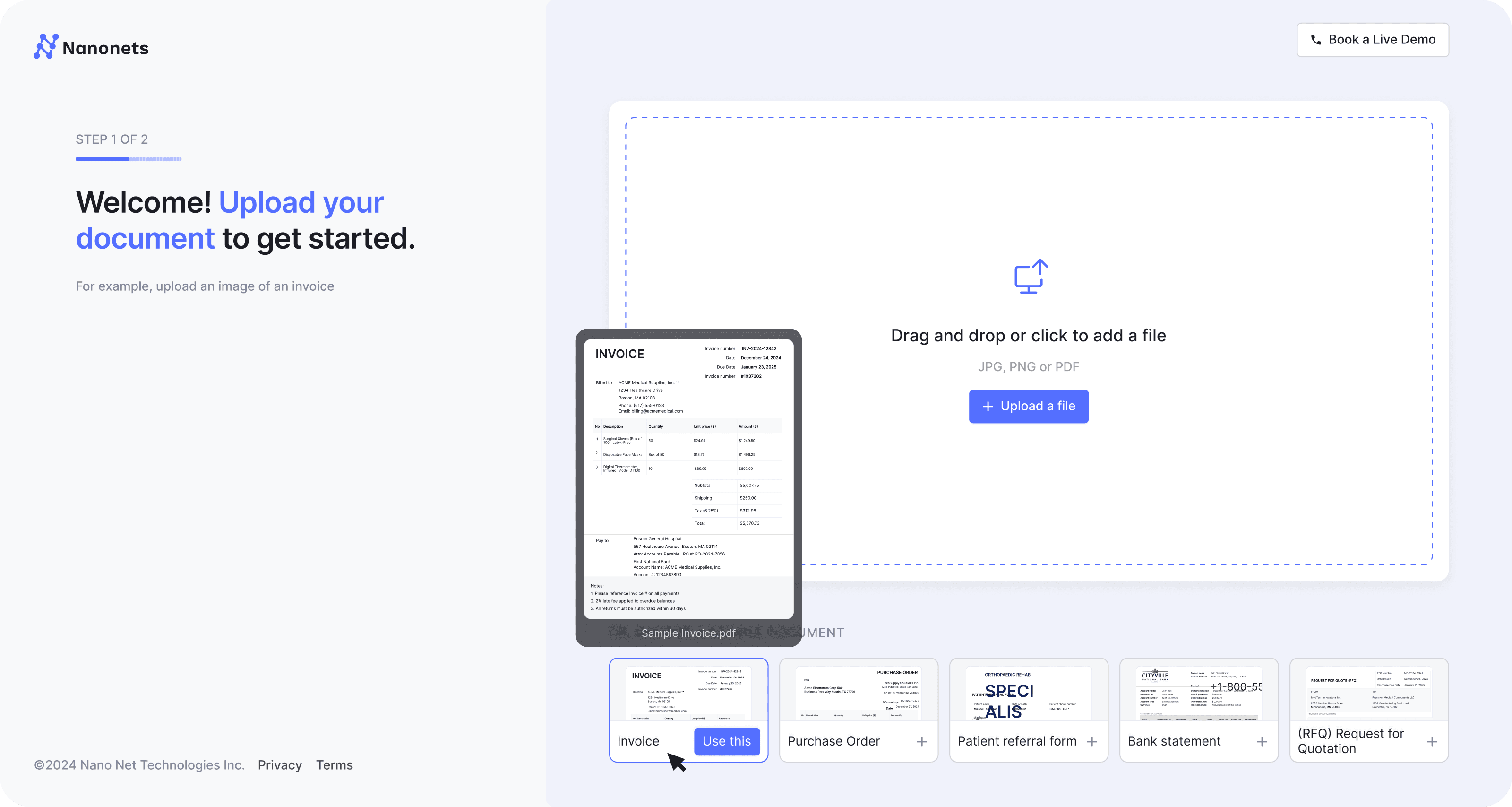
Sample Document Injection
Users could try the product instantly using a ready sample instead of being blocked by their own document. This reduced friction at the upload stage.
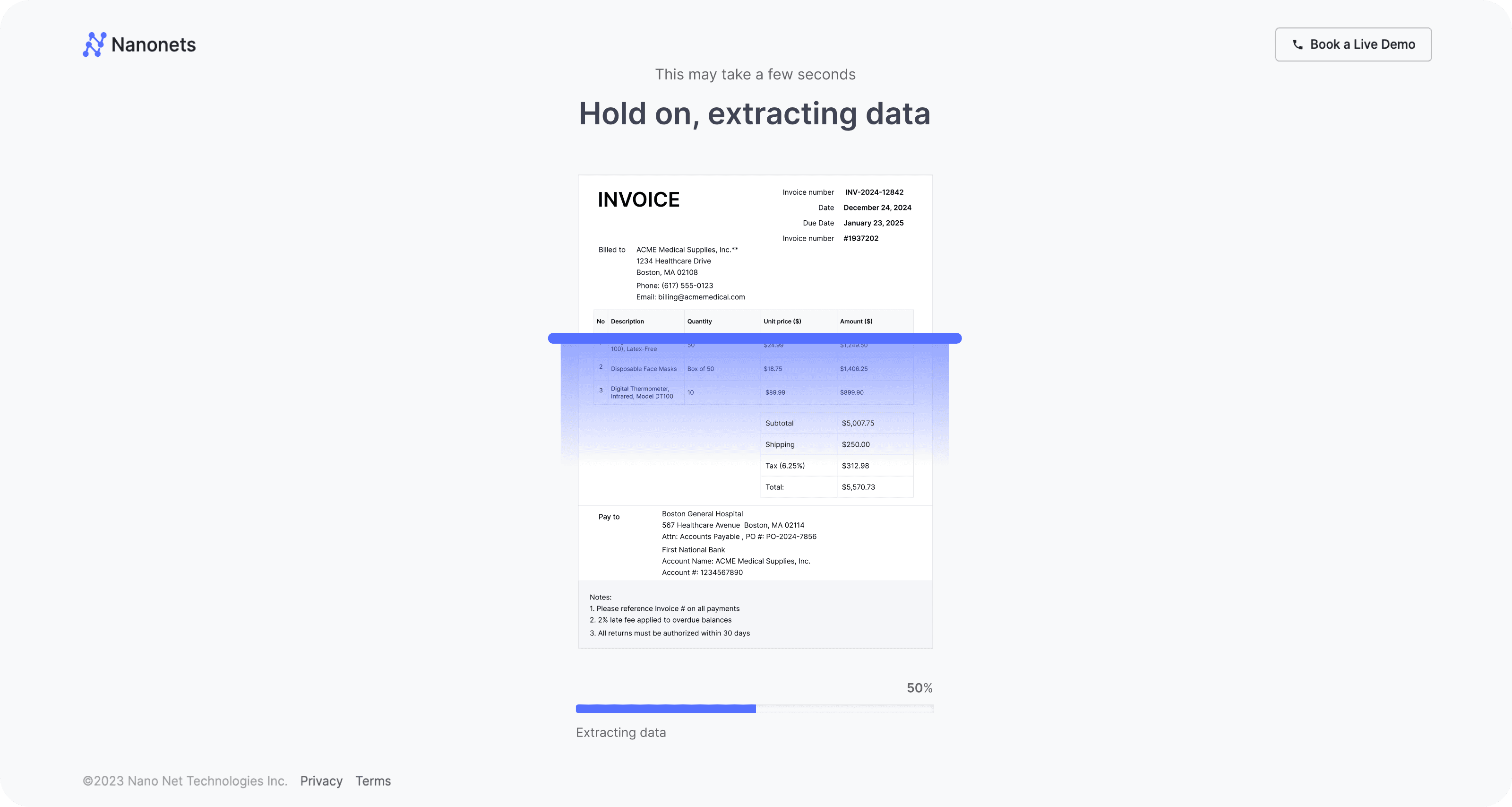
Extraction Transparency Layer
Replaced silent processing with visible AI progress. Users could see upload, detection, extraction, and validation steps in real time.
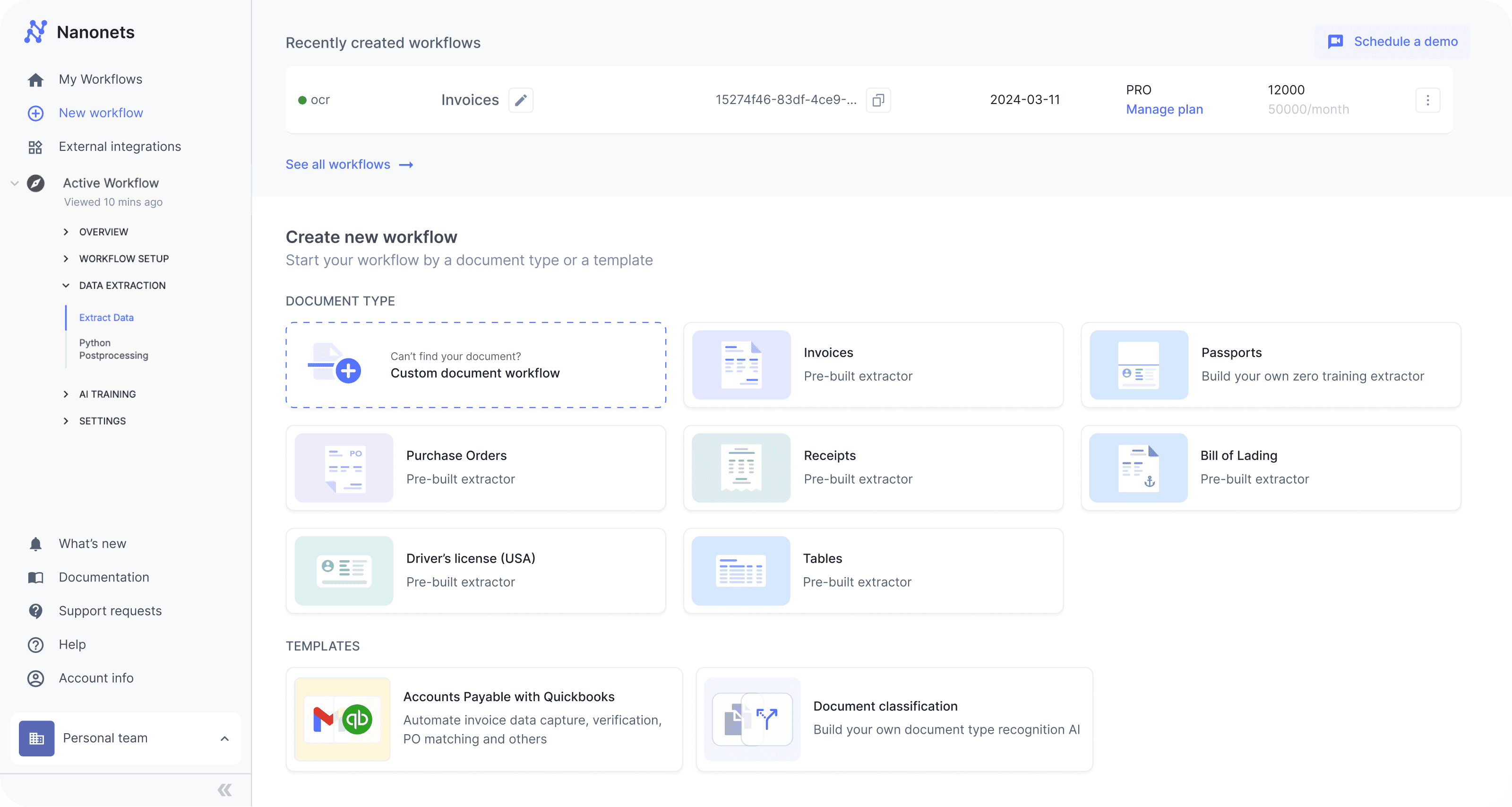
Dashboard-First Landing
Post-extraction, users landed on a structured dashboard instead of inside a nested workflow screen. This improved chronology and clarity of next actions.
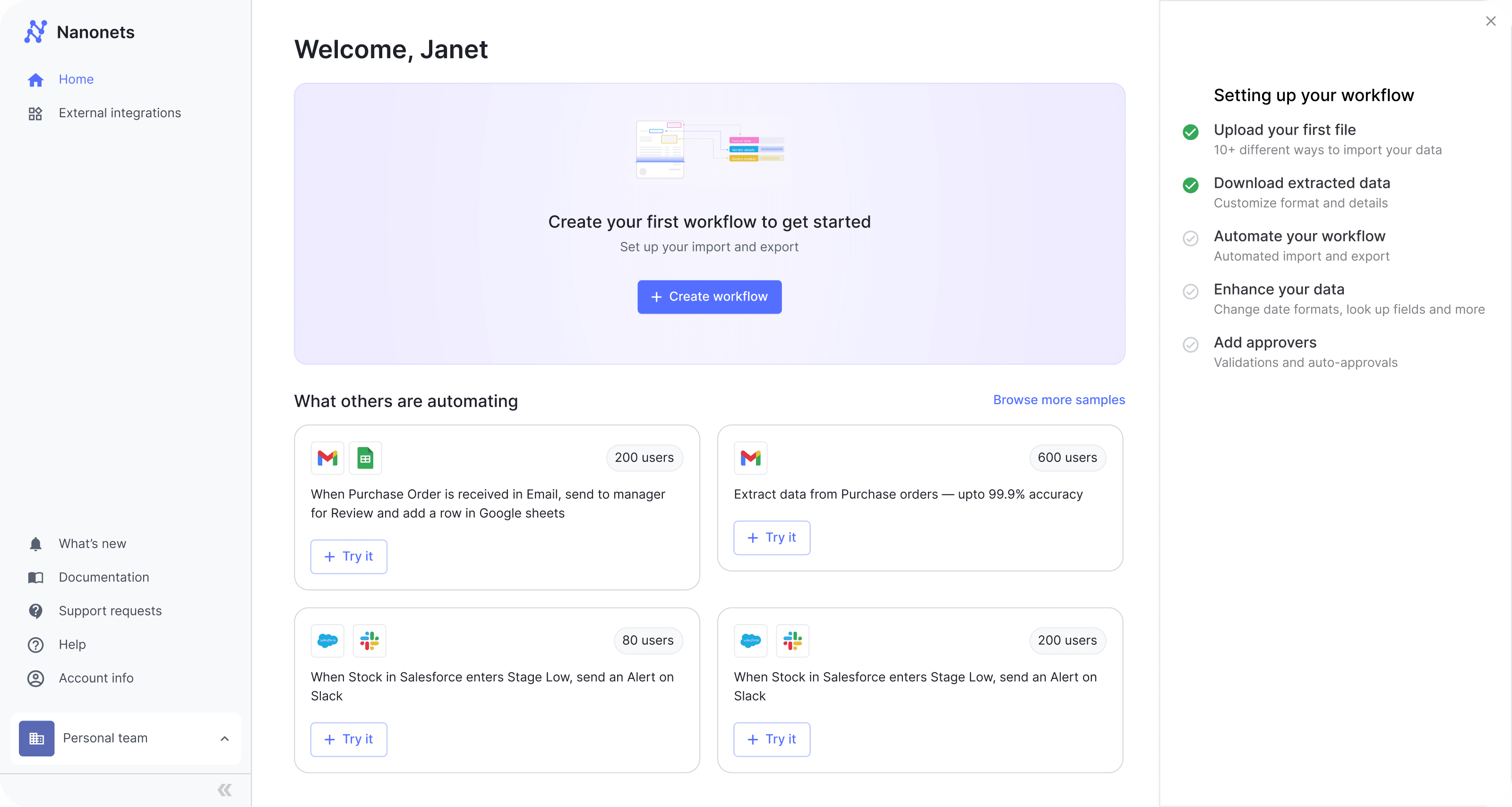
Action Chronology Checklist
A persistent progress tracker guiding users from upload to approval to integration. It turned onboarding into a sequenced journey rather than an open-ended exploration.
Outcome
Onboarding drop-offs were reduced from nearly 70 percent toward the sub-40 percent target.
Users progressed beyond initial upload into workflow configuration and repeatable usage.
First interaction shifted from uncertainty to guided progression, improving early activation and downstream product adoption.